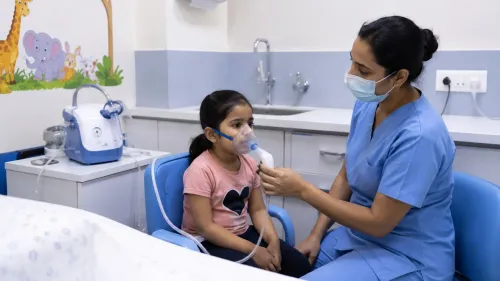

A cough after a cold can linger, but duration, triggers, nighttime symptoms, and breathing effort help separate recovery from a problem needing assessment. You will learn when to seek emergency care, what to record, how clinicians investigate wheezing, and why diagnosis and treatment often require follow-up rather than one test or one visit.
Key takeaways
- A cough lasting over four weeks needs clinical assessment.
- Seek emergency help for severe breathing difficulty, blue lips, or unusual drowsiness.
- Record triggers, timing, sounds, fever, medicines, and breathing changes.
- Treatment review checks symptoms, inhaler technique, triggers, and nighttime coughing.
How long is too long for a child’s cough?
A cough lasting more than four weeks is chronic and needs clinical assessment, not repeated over-the-counter treatment. Persistent cough in children can follow an infection, but duration and pattern matter.
| Pattern | What it may mean | What to do |
|---|---|---|
| Post-viral cough | A dry cough can linger for several weeks after a cold | Arrange review if it is worsening, limiting sleep or activity, or passes four weeks |
| Bronchiolitis | Cough and breathing symptoms can take longer to settle, especially in infants | Seek assessment if feeding or breathing deteriorates |
| Pneumonia | Recovery depends on severity and treatment; cough can outlast fever | Reassessment is needed for returning fever, fast breathing, chest pain, or poor energy |
| Repeated viral infections | Back-to-back colds can make the cough seem continuous | Track symptom-free days and arrange review if there is no clear improvement |
| Possible asthma | Night cough in children, exercise-related cough, cold-air symptoms, coughing with laughing or crying, recurrent episodes, or symptoms after viral infections | Request a pediatric assessment; cough alone cannot confirm asthma |
Other causes include protracted bacterial bronchitis, upper-airway cough syndrome from nasal drainage, reflux, and habit cough. A sudden cough during eating or play raises concern for a swallowed or inhaled foreign object, especially after choking or with one-sided breathing sounds.
A clinician can distinguish these patterns and choose testing or treatment; antibiotics do not treat viral coughs or asthma.
Is it wheezing, noisy breathing, or an emergency?
Wheezing is usually a continuous, high-pitched, musical or whistling sound coming from the chest, often loudest when your child breathes out. What wheezing sounds like can change with the severity of airway narrowing, and a child with asthma may have no audible wheeze between episodes.
Use these clues to separate wheezing from other noisy breathing:
- Nasal congestion sounds blocked, snuffly, or wet and often changes after clearing the nose.
- Mucus rattling can shift or disappear after coughing.
- Throat sounds come from the upper airway rather than deep in the chest.
- Stridor versus wheezing: stridor is harsh or high-pitched during breathing in, while wheezing usually sounds musical during breathing out.
Seek emergency care immediately for these emergency breathing symptoms:
- Blue or grey lips, face, or skin
- Severe chest indrawing in children, or pulling in around the ribs, below the ribs, or at the neck
- Pauses in breathing
- Unusual drowsiness, confusion, or poor responsiveness
- Inability to speak or cry normally because of breathlessness
- Choking or sudden breathing difficulty after eating or playing
- Breathing that worsens despite prescribed medicine
For infants, markedly reduced feeding or fewer wet diapers also needs urgent assessment because breathing illness and dehydration can worsen together. Don’t wait for a wheeze if your child looks exhausted or struggles to breathe.
Why age, choking, infection, and exposure change the level of concern
A first episode of infant wheezing is not automatically asthma. Bronchiolitis in children younger than two is usually managed with fluids, nasal suction when congestion interferes with feeding or breathing, and checks of breathing and feeding. Routine albuterol, corticosteroids, antibiotics, and chest physiotherapy are not recommended for typical bronchiolitis.
Arrange prompt assessment when the child is under three months, was born prematurely, has heart or lung disease, or has poor weight gain. Age and underlying health change how quickly breathing can deteriorate.
- Seek evaluation after sudden coughing or wheezing during eating or play. Foreign-body aspiration can cause witnessed choking, an abrupt one-sided wheeze, unequal breath sounds, or a cough that continues after choking, even if the child later appears well. A normal chest X-ray does not reliably exclude an inhaled object.
- Do not use antibiotics for viral colds, ordinary viral wheeze, or asthma. They treat bacterial conditions identified by a clinician, such as pneumonia, bacterial sinusitis, or protracted bacterial bronchitis; unnecessary courses can cause side effects and antibiotic resistance.
- Remove tobacco smoke and vaping exposure. Secondhand smoke and asthma are linked through irritated, more reactive airways, and exposure can worsen cough or wheeze.
- Avoid over-the-counter cough and cold medicines as a substitute for assessment. The FDA does not recommend them under age two, and many labels say “do not use” under age four; dosing errors and side effects can be serious, while these products do not treat asthma or airway inflammation.
What to record before the pediatric respiratory assessment
Bring a simple timeline and your child’s medicines to the pediatric respiratory assessment. Specific details help the clinician separate asthma patterns from infection, aspiration, and other causes.
1. Write the symptom start date, fever, nighttime episodes, and whether symptoms followed a cold or another illness.
2. Note exercise, cold-air, laughing, and crying triggers, plus any tobacco-smoke or vaping exposure in the home or car.
3. Count breathing rate for one full minute while your child is calm, not crying or feverish.
4. List every medicine, including the name and dose, then record how quickly it helped and how long relief lasted.
5. Record feeding, drinking, and wet diapers. Capture a short video of noisy breathing if it is safe and does not delay urgent care.
The assessment may include oxygen saturation in children, respiratory rate, work of breathing, chest examination, growth review, allergy history, and family history of asthma or allergies. Chest radiography is reserved for selected patterns. Spirometry for asthma is usually considered from about age five, when reliable blows are possible.
Preschool asthma diagnosis often relies on repeated patterns, reversibility, examination findings, and response to a supervised inhaled-treatment trial. One test or visit cannot reliably confirm asthma in a preschool child.
Sattva Pediatric - Dr. Rishabh K. Shah can help organise the history, review medicines, and decide whether follow-up or testing is appropriate; plan reassessment when symptoms recur or treatment changes.
Related services
Pediatric Respiratory Illness & Asthma Treatment Pediatric Respiratory Illness & Asthma Treatment at Sattva Pediatric Clinic – Dr. Rishabh Shah Dr. Rishabh Shah at Sattva Pediatric Clinic, Lalbaug, South Mumbai, provides expert diagnosis and... View service → |
Feeding Room & Nebulisation Facility Feeding Room & Nebulisation Facility at Sattva Pediatric Clinic Sattva Pediatric Clinic, Lalbaug, South Mumbai, is designed to provide a comfortable and child-friendly experience for... View service → |
How treatment decisions and follow-up show whether control is improving
For children aged five and older who can perform reliable blows, spirometry supports asthma when airflow varies: a reduced FEV1/FVC ratio improves meaningfully after a bronchodilator or changes over time. Normal spirometry at one visit does not fully exclude asthma, so the clinician considers symptom patterns and repeat testing.
Persistent asthma is usually managed with the lowest effective dose of inhaled corticosteroids for children. During pediatric asthma follow-up, review symptoms, growth, activity, adherence, and inhaler technique. A pressurised metered-dose inhaler generally delivers medicine better through a valved holding chamber; younger children may need a mask.
Demonstrate spacer technique and have the child demonstrate it back.
Use the quick-relief inhaler only as written in the asthma action plan, not on an improvised schedule. Arrange reassessment if:
- The child needs it more often than directed.
- Relief does not last.
- Symptoms wake the child at night.
- Breathing limits play, exercise, or school activities.
- Medicine seems ineffective because doses are missed or the spacer is used incorrectly.
Follow-up may mean correcting technique, checking adherence, adjusting medicine, or repeating visits before increasing treatment. This response pattern also helps separate asthma from viral wheeze, an airway abnormality, aspiration, or another cause.
Frequently asked questions
How long is too long for a child’s cough?
A cough lasting more than four weeks is chronic and needs clinical assessment. A shorter cough also needs review when it worsens, disrupts sleep, follows choking, or occurs with breathing difficulty.
How can you tell wheezing from noisy breathing or an emergency?
Wheezing is a musical or whistling sound, usually during breathing out. Stridor is a harsh, high-pitched sound during breathing in. Severe breathing effort, blue lips, pauses in breathing, inability to speak or drink, or unusual drowsiness require emergency care.
Why do age, choking, infection, and exposure affect concern?
Infants have narrower airways, choking can block an airway suddenly, infections can cause prolonged cough, and smoke, dust, pets, mould, or air pollution can trigger symptoms. These details change the urgency and possible causes.
What should you record before a pediatric respiratory assessment?
Record when symptoms began, cough timing, breathing sounds, fever, sleep disruption, exercise limits, triggers, choking episodes, sick contacts, smoke or pollution exposure, medicines given, and response to treatment. A short recording of the breathing sound can also help.
How do treatment decisions and follow-up show whether control is improving?
Follow-up compares daytime and nighttime symptoms, activity limits, rescue-medicine use, flare-ups, and examination findings. It also checks inhaler and spacer technique, medicine adherence, trigger reduction, and whether the treatment plan needs adjustment.