The first days after birth involve more than checking whether a baby looks well: temperature, breathing, glucose, feeding, weight, hydration, jaundice, and screening results can change quickly. By the end, you will know what neonatal care checks, how to monitor your baby at home, which records to confirm before discharge, and when a warning sign needs same-day or emergency assessment.
Key takeaways
- Drying and early checks help prevent heat loss and identify breathing problems.
- Track feeding, temperature, glucose, wet nappies, and stools during the first days.
- Ask how jaundice and newborn screening results were assessed before discharge.
- Seek urgent care for breathing difficulty, poor feeding, fever, or unusual sleepiness.
What happens in the first hours after birth
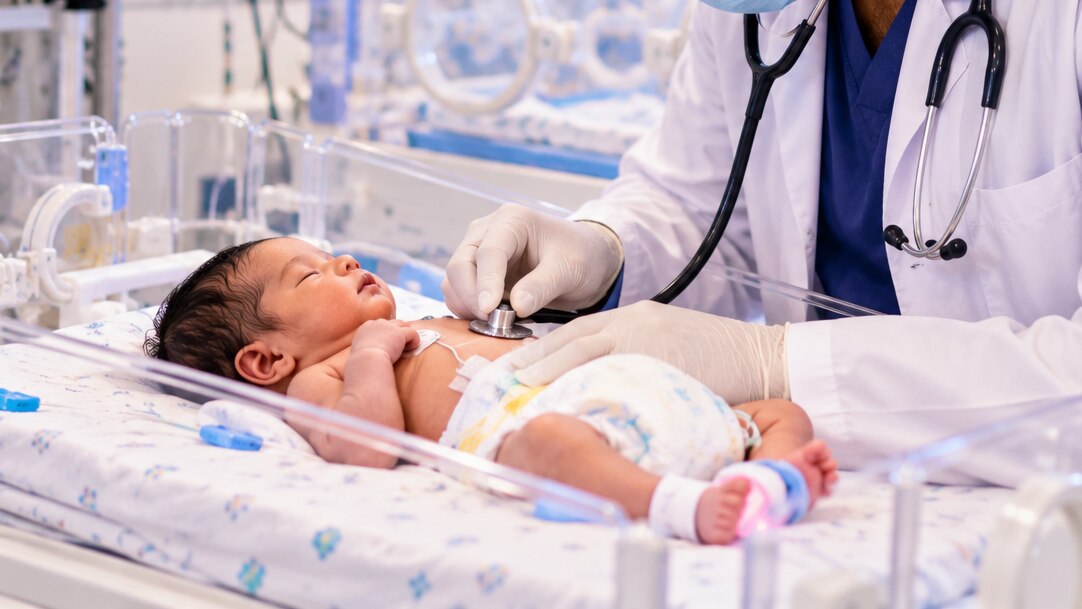
Immediately after birth, the team dries the baby thoroughly and checks breathing, colour, muscle tone, heart rate, and temperature. This essential newborn care limits heat loss while identifying a baby who needs help to breathe.
Place a stable newborn directly in skin-to-skin contact, cover the back and head, and delay bathing; WHO recommends waiting at least 24 hours when possible.
- Complete a breathing assessment. If breathing is absent, gasping, or laboured, trained staff provide stimulation, ventilation, and further resuscitation without delay.
- Perform an oxygen assessment in newborns when breathing or colour is abnormal, using pulse oximetry and clinical examination rather than judging oxygen levels by appearance alone.
- Delay cord clamping for at least one minute when the baby does not need immediate resuscitation.
- Help with breastfeeding during the first hour, then examine the baby for birth injury, infection, and other complications.
| Situation | Immediate action | Why it matters |
|---|---|---|
| Stable transition | Keep the baby warm, support skin-to-skin contact, and observe breathing and colour | Prevents hypothermia and detects deterioration |
| Breathing or colour concern | Check oxygen saturation and provide respiratory support | Low oxygen can worsen quickly |
| Risk of low blood glucose | Check glucose when the baby is premature, small, large, symptomatic, or born to a mother with diabetes | Early treatment prevents neurological harm |
How feeding, temperature, glucose, and output show whether a newborn is coping
A healthy breastfed newborn commonly feeds 8–12 times in 24 hours; newborn feeding frequency matters more than a rigid clock schedule. An effective latch keeps the baby’s mouth wide, with rhythmic sucking and audible swallowing. The baby relaxes after feeding, while a bottle-fed infant takes feeds without persistent coughing, choking, or exhaustion.
Clinicians and parents track several linked signs:
- Wet diapers increase each day: at least one on day 1, two on day 2, and about six in 24 hours by days 4–5. Dark urine, urate crystals after the first days, or progressively fewer wet diapers needs assessment.
- Weight is checked against birth weight. Loss above 10% requires review of latch, milk transfer, hydration, stooling, jaundice, illness, and whether targeted supplementation is needed.
- Newborn blood glucose checks are used for babies at risk, such as those born preterm, small or large for gestational age, or showing poor feeding, tremors, or unusual sleepiness. A low result needs the newborn team’s treatment plan.
- An axillary temperature near 36.5–37.5°C indicates effective thermal care. Skin-to-skin contact, a hat, and suitable clothing help; overheating, a cold trunk, or a persistently abnormal reading requires medical assessment.
A baby who is hard to wake, repeatedly feeds poorly, vomits persistently, or shows dehydration signs should be assessed the same day. Do not solve poor intake by imposing a stricter schedule; find out why milk is not transferring.
How jaundice and newborn screening findings are evaluated before discharge
A yellow face does not show how high bilirubin is. Newborn jaundice is evaluated with bilirubin testing, using the baby’s age in hours, gestational age, and neurotoxicity risk factors to place the result against an hour-specific treatment threshold. The 2022 AAP guideline recommends measuring bilirubin before discharge and arranging follow-up according to that result.
Phototherapy is used when the level reaches the applicable threshold, not simply because the skin looks yellow.
1. Jaundice during the first 24 hours needs prompt bilirubin measurement because it is more concerning than typical physiologic jaundice. Yellowing that worsens, reaches the palms or soles, or occurs with poor feeding, unusual sleepiness, or abnormal muscle tone needs urgent assessment.
2. Pulse-oximetry screening for critical congenital heart disease is usually done at or after 24 hours, or as late as possible before an earlier discharge. A pass lowers concern for certain serious defects but does not rule out every heart problem or future symptoms.
3. Newborn hearing screening should be completed before 1 month. A failed first screen does not confirm hearing loss; it requires timely rescreening and diagnostic testing when needed, with diagnosis targeted by 3 months and intervention by 6 months.
4. Before leaving, confirm the bilirubin result, screening outcomes, and follow-up plan. A visit at 3–5 days reassesses weight, feeding, hydration, elimination, jaundice, and any unfinished screening.
What the first follow-up checks, especially for high-risk newborns
A neonatal follow-up visit usually occurs at 3–5 days of age, or sooner if discharge happened before 48 hours or concerns were present. The clinician reassesses:
- Feeding technique, milk transfer, vomiting, and feeding frequency
- Weight and loss from birth weight
- Wet diapers, stools, hydration, and temperature
- Jaundice, breathing, heart rate, and the umbilical stump
- Physical findings from birth and signs of infection
- Newborn screening, hearing screening, and any pending test or referral
Weight loss above 10% needs prompt assessment, not an automatic switch to formula. The clinician checks feeding and hydration first, then plans targeted supplementation or closer review when needed.
Premature, low-birth-weight, or medically high-risk babies need a more individual schedule because feeding difficulty, low glucose, temperature instability, breathing pauses, and infection can develop after discharge. Visits may include closer weight checks, feeding plans, oxygen review, and apnea monitoring when prescribed. Ask which symptoms require immediate assessment and which numbers to record at home.
For a premature infant, corrected age guides developmental expectations and some follow-up decisions. Corrected age subtracts the weeks born before 40 weeks from chronological age. Specialist appointments may include retinopathy of prematurity follow-up, repeat hearing assessment, developmental surveillance, and review of medicines or home equipment.
Keep every appointment even when the baby appears well; early problems are easier to correct before growth or development falls behind.
Which warning signs require same-day or emergency newborn care
A newborn with a danger sign should not be watched overnight. Count breathing for a full minute while the baby is calm; fast breathing 60 breaths per minute or more, chest indrawing, blue or grey lips, repeated pauses, or grunting requires emergency assessment.
| Sign | What to do | Why it matters |
|---|---|---|
| Convulsion, unresponsiveness, or severe lethargy | Seek emergency care immediately | The baby may have a serious infection, oxygen problem, or metabolic emergency |
| Cannot feed, repeatedly vomits, or has far fewer wet diapers | Arrange same-day medical assessment | Dehydration, low glucose, infection, or poor milk transfer can worsen quickly |
| Fever 38°C in a baby under 3 months | Seek urgent assessment today; do not give medicine first unless instructed | Fever at this age can signal a serious infection |
| Temperature below 35.5°C after removing a cold environment | Obtain urgent medical assessment and keep the baby skin-to-skin while arranging care | Low temperature can accompany infection or dangerous heat loss |
| Yellow skin in the first 24 hours, or yellow palms and soles | Arrange prompt bilirubin testing and medical review | This pattern is not safely judged by appearance alone |
| Breathing difficulty, blue colour, or severe chest indrawing | Go to emergency care now | Oxygen levels can fall rapidly |
Do not force-feed, cool a feverish baby with cold water, or rely on home warming for persistent low temperature. Sattva Pediatric - Dr. Rishabh K. Shah can help assess a concerning newborn, while premature or high-risk babies need the escalation plan given at discharge.
Related services
Premature Infant High Risk Follow-up Premature Infant High Risk Follow-up Premature Infant & High-Risk Baby Follow-up at Sattva Pediatric Clinic – Dr. Rishabh Shah Dr. View service → |
Pediatric Consultation & Neonatal Care Pediatric Consultation & Neonatal Care at Sattva Pediatric Clinic – Dr. Rishabh Shah Dr. Rishabh Shah at Sattva Pediatric Clinic, Lalbaug, South Mumbai, offers comprehensive Pediatric... View service → |
Frequently asked questions
What happens in the first hours after birth?
The team dries the baby and checks breathing, colour, muscle tone, heart rate, and temperature. These checks identify heat loss and breathing problems early.
How do clinicians know whether a newborn is coping?
They assess feeding, temperature, blood glucose when indicated, wet nappies, and stools. Changes in these findings can signal that the baby needs review.
How are jaundice and newborn screening findings evaluated before discharge?
The care team examines the baby for jaundice, measures bilirubin when needed, and reviews newborn screening results or explains which results are pending.
What warning signs require same-day or emergency newborn care?
Seek urgent assessment for breathing difficulty, blue or grey colour, fever or low temperature, repeated vomiting, poor feeding, markedly fewer wet nappies, or unusual difficulty waking.